Working with the ESP32-S3 has always been about pushing boundaries—especially when it comes to multimedia. While audio on microcontrollers has become fairly common, video is still considered “out of reach” for most embedded setups.
That’s what makes the lightweight H.264 support from Espressif Systems so interesting.
Native H.264 Support on ESP32-S3
Espressif provides a compact H.264 encoder and decoder component as part of their ecosystem. This is a big deal: H.264 (also known as AVC) is one of the most widely used video codecs, powering everything from streaming platforms to embedded vision systems.
On a resource-constrained device like the ESP32-S3, having access to a optimized software codec opens the door to:
- Low-bandwidth video streaming
- Embedded camera applications
- Real-time video processing
- IoT devices with visual feedback
The Problem: Not Arduino-Friendly
While the underlying H.264 component is powerful, it’s not immediately usable from the Arduino environment. Most of Espressif’s examples and APIs are designed for ESP-IDF, which can be a barrier if you’re working in Arduino.
That gap is exactly what I wanted to close.
My Solution: Arduino H.264 Library for ESP32-S3
I created an Arduino-compatible wrapper library that makes it straightforward to use H.264 encoding and decoding directly on the ESP32-S3.
The goal was simple:
- Keep the API clean and Arduino-style
- Hide ESP-IDF complexity
- Enable quick integration into existing projects
Key Features
- H.264 encoding
- H.264 decoding
- Integrate with the ESP32 cameras
- RDP Packetization and Publishing via UDP
- Lightweight abstraction over Espressif’s component
- Designed specifically for ESP32-S3
- Easy integration into Arduino projects
Example
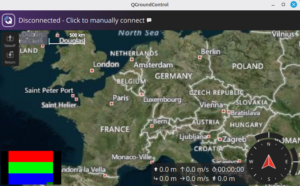
As a demo, here is an example where I can receive a test video in QGroundControl:
What’s Next?
- In the next blog, I will be deomonstrating how you can use a “Drawing API” to publish an animated video.
If you’re working on something similar, contributions and feedback are always welcome.
H.264 on a microcontroller might sound ambitious—but with the ESP32-S3, it’s surprisingly within reach.

0 Comments